Punctures from Road Debris
Sharp objects like nails, screws, glass, and industrial debris are the most frequent causes of a flat tire. These objects pierce the tread, causing either a slow hiss or rapid air loss. Construction zones and highway shoulders are notorious hotspots for collecting this type of hazardous debris.
Potholes and Structural Road Damage
New England winters take a heavy toll on our streets. Hitting a deep pothole at high speed can pinch the internal structure of your tire against the wheel rim. This often results in an immediate sidewall bulge or a violent blowout, rendering the tire completely unusable.
Under-Inflation or Over-Inflation
Incorrect tire pressure alters how your vehicle distributes weight. Under-inflated tires flex excessively, generating massive internal heat that can cause the tread to separate. Over-inflated tires become stiff and brittle, making them far more vulnerable to impact damage from stones or potholes.
Natural Wear and Tear
As miles accumulate, your tire tread naturally wears down. Bald tires lose their protective outer layer, leaving them highly susceptible to punctures from everyday road hazards that a newer tire would easily resist.
Critical Flat Tire Safety Tips for the Roadside
When a tire fails while you are driving, your immediate priority must shift from your schedule to your personal safety. A highway shoulder is a high-risk environment. Implementing strict flat tire safety tips minimizes the danger to you, your passengers, and other drivers.
EMERGENCY SAFETY CHECKLIST
1. Signal early and signal clearly
2. Guide your vehicle to a flat, hard surface
3. Engage your parking brake immediately
4. Activate your hazard lights
5. Deploy safety flares or reflective triangles if available
Pull Over in a Safe Location
The moment you suspect a flat, do not slam on the brakes. Hold the steering wheel firmly, ease off the gas pedal, and scan the area for a straight, flat stretch of road. Avoid stopping on curves, hills, or narrow bridges where oncoming traffic cannot see you clearly. If you are on a busy highway, try to take the nearest exit, even if it means driving slowly on the rim for a short distance to reach a safe parking lot.
Maximize Your Visibility
Turn on your hazard lights immediately to alert other motorists that your vehicle is disabled. If you carry an emergency roadside kit, place reflective triangles or safety flares well behind your vehicle to give oncoming traffic plenty of advance warning, especially during nighttime or low-visibility weather conditions.
Keep Passengers Secure
If you must pull over onto a busy highway shoulder, it is generally safest for all passengers to remain inside the vehicle with their seatbelts fastened. If you judge that the vehicle is at risk of being struck from behind, carefully exit through the side doors facing away from traffic and move well past the guardrail into a safe, grassy area.
How to Change a Flat Tire Safely
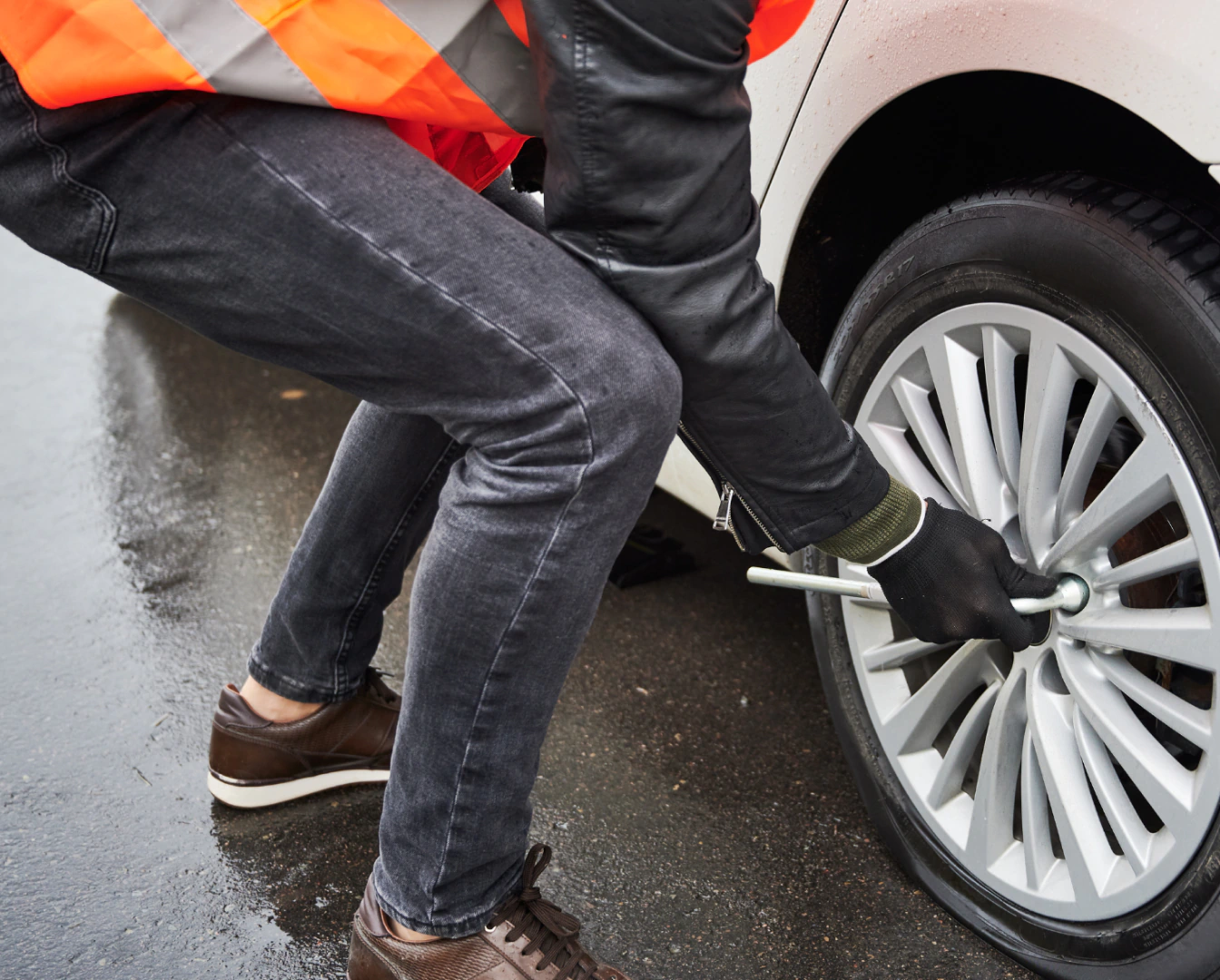
If you possess a functional spare tire, a car jack, and a lug wrench, you might decide to tackle the replacement yourself. Knowing how to change a flat tire safely ensures you complete the task without damaging your vehicle or causing personal injury.
Step 1: Secure the Vehicle
Ensure your car sits on flat, stable ground. Engage your parking brake as tightly as possible to prevent the vehicle from rolling. If you have wheel chocks, bricks, or large stones, place them behind the tires on the opposite end of the car to lock it securely in place.
Step 2: Loosen the Lug Nuts
Before lifting the vehicle off the ground, use your lug wrench to break the resistance on the lug nuts. Turn them counterclockwise. At this stage, only loosen them about a quarter to a half turn; do not remove them completely yet. Keeping the tire on the ground prevents it from spinning while you exert force on the wrench.
Step 3: Position the Jack Correctly
Consult your vehicle owner’s manual to locate the specific jacking points on your car’s frame. Placing the jack against weak plastic molding or floorboards can crush the vehicle body. Once positioned against the solid metal frame, slowly raise the jack until the flat tire clears the ground by a few inches.
Step 4: Swap the Tires
Remove the loosened lug nuts entirely and pull the flat tire toward you off the wheel hub. Slide your spare tire onto the bolts, ensuring the air valve faces outward. Hand-tighten the lug nuts back onto the bolts as far as they will go.
Step 5: Lower and Final Tighten
Carefully lower the jack until the spare tire makes firm contact with the ground but does not yet bear the full weight of the vehicle. Use the lug wrench to tighten the nuts using a star pattern, which means tightening opposite nuts rather than consecutive ones. This ensures the wheel seats are perfectly evenly. Lower the vehicle completely, remove the jack, and give the lug nuts one final check for tightness.
When to Call for Professional Flat Tire Roadside Assistance
While changing a tire is a great skill to have, there are many real-world scenarios where attempting a DIY swap is either impossible or incredibly dangerous. Recognizing when to use professional roadside assistance for flat tires keeps you out of harm’s way.
- You Lack the Proper Tools: Many modern vehicles no longer come equipped with a spare tire or a jack from the factory, offering only temporary inflation kits that cannot fix major sidewall gashes.
- Dangerous Traffic Conditions: If your flat tire is on the left side of the vehicle, facing active traffic lanes on a busy highway, attempting a manual change exposes your body directly to speeding vehicles.
- The Lug Nuts Are Seized: Rust, corrosion, or over-tightening during previous maintenance can lock lug nuts so tightly that standard hand tools cannot budge them.
- Physical Limitations or Extreme Weather: Heavy rain, freezing snow, or personal physical limitations can make manual labor on a dark roadside highly impractical or hazardous to your health.
Opting for an established local team ensures that professional equipment, high-visibility warning lights, and trained operators handle the heavy lifting while you stay safe inside a comfortable cabin.
Exploring Roadside Tire Replacement Options
When a tire suffers significant structural damage, a simple roadside change might not be enough to solve your problem. Understanding your options helps you make the right choice to protect your vehicle’s drivetrain and your wallet.
Temporary Spares (“Donuts”)
Most passenger vehicles use a compact spare tire. These temporary wheels are engineered solely to get you to the nearest repair shop. They feature strict limitations: you should generally not drive faster than 50 miles per hour, and you should avoid driving on them for more than 50 total miles. Their limited traction and smaller size can alter your vehicle’s handling and braking capabilities.
Full-Size Spares
Some larger SUVs and trucks carry a full-size spare tire. While these allow for normal driving dynamics, they should still be inspected regularly to ensure they hold proper air pressure. If the tread depth on your full-size spare varies significantly from your active tires, it can place unwanted stress on an all-wheel-drive system.
Professional Vehicle Recovery
If your tire blowout caused you to lose control and slip off the roadway into a ditch or an embankment, standard roadside tools will not suffice. In these complex scenarios, using professional accident recovery services ensures your vehicle is safely brought back to level ground without sustaining secondary frame or suspension damage.
How to Prevent Flat Tires and Avoid Future Roadside Emergencies
The most effective roadside emergency is the one that never happens. Incorporating proactive maintenance habits into your vehicle care routine drastically reduces the likelihood of suffering an unexpected tire failure.
Check Tire Pressure Monthly
Tires naturally lose air pressure over time and fluctuate rapidly with changing seasonal temperatures. Use a reliable tire pressure gauge once a month when the tires are cool to verify they match the specific pounds per square inch (PSI) listed on the sticker inside your driver’s door jamb.
Rotate and Balance Regular Intervals
Front tires wear out differently than rear tires due to steering forces and engine weight distribution. Rotating your tires every 5,000 to 7,000 miles ensures even tread wear across all four wheels, prolonging their operational life and preserving balanced traction.
Conduct Visual Inspections
Take a few moments every few weeks to inspect your tires visually. Look for embedded gravel, small nails, deep sidewall cracks, or unusual bulging. If you notice uneven tread wear, such as the inside edge wearing down faster than the outside, schedule an alignment check with a local technician immediately.
Maintain Your Spare Tire
A spare tire is completely useless if it is flat when you need it most. Whenever you check your active tires, check the pressure in your spare tire as well. Compact spares typically require a much higher pressure, often around 60 PSI, than standard tires.
Keeping Traffic Moving Safely
Tire emergencies can happen to anyone, anywhere, at any hour of the day. By keeping calm, prioritizing visibility, and understanding your vehicle’s mechanical limits, you can easily navigate a flat tire without letting it ruin your week. Whether you require immediate help on a dark highway or need your vehicle transported to a local repair shop via dedicated 24/7 emergency towing, making smart, safety-focused decisions is the ultimate way to handle any roadside challenge.
When an unexpected tire failure leaves you stranded on the side of the road, we stand ready to help you get moving again. As a local, family-owned business since 2004, Supreme Towing & Recovery brings decades of dedicated industry experience directly to your location in Manchester, NH. We pride ourselves on absolute honesty and reliability; when we quote you an arrival time, we show up exactly when we say we will, eliminating the guesswork and long delays often associated with other companies. Our highly trained team holds specialized Liftmaster certifications and maintains active partnerships with the State Police for official rotations, ensuring your vehicle is handled with the highest standard of professionalism. Whether you need an emergency tire change service, a battery jumpstart, or a safe haul via our flatbed roadside assistance, you can count on us for straightforward, dependable service 24 hours a day, 7 days a week. Give us a call at (603) 626-9555 to get prompt assistance from a team that always keeps its word.