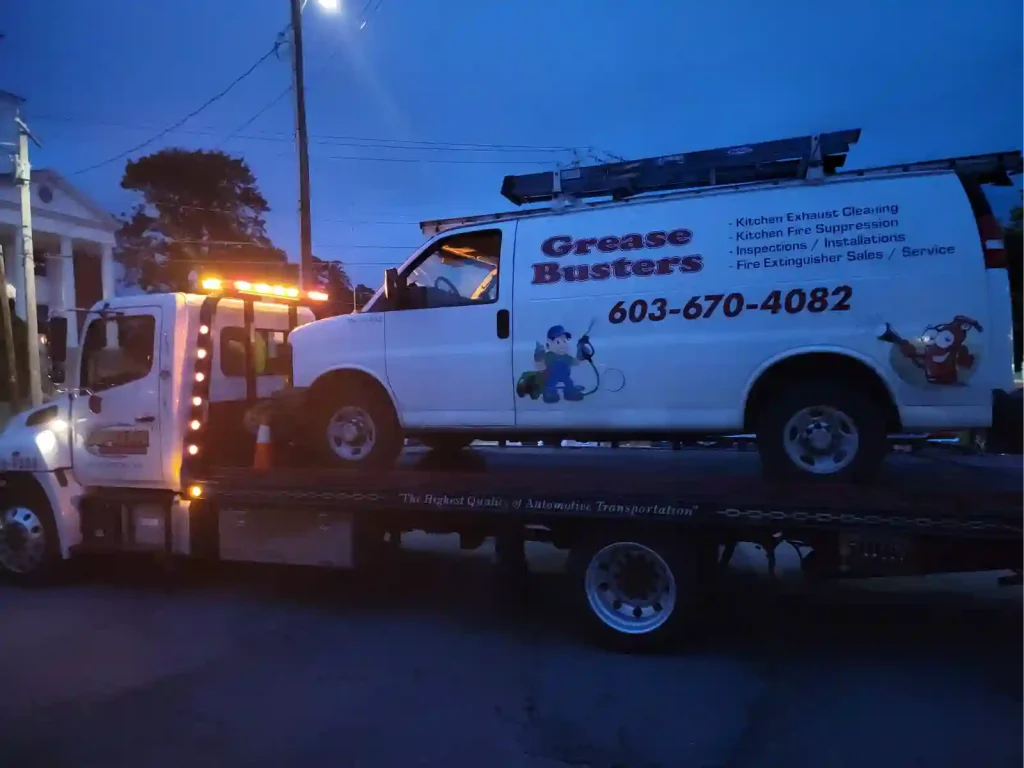
Verify Your Equipment and Vehicle Compatibility Before You Start
Before you hook up any tow rig, confirm your tow vehicle is rated for the job. Check your owner’s manual for maximum towing capacity, which includes the weight of the disabled car plus the tow dolly or trailer. Exceeding this limit can damage your transmission, brakes, and suspension, leaving you stranded with two broken vehicles instead of one.
Inspect your tow bar, safety chains, tow dolly, or trailer for rust, cracks, or worn pins. Safety chains must be rated for at least the weight of the towed vehicle and crossed under the hitch to catch the tongue if it disconnects. Your hitch receiver should match the ball size exactly — a 2-inch ball will not secure a 1 7/8-inch coupler, and vice versa.
Verify that both vehicles have functioning lights. Attach a wiring harness or magnetic tow lights to the disabled car so brake lights, turn signals, and running lights remain visible to traffic behind you. In Manchester and across New Hampshire, visibility becomes critical during winter months when early sunsets and snow reduce sightlines. Test every light before you leave the lot.
If your situation involves a vehicle stuck off-road, a flooded engine, or accident damage, the risks multiply. Professional recovery services bring winches, flatbeds, and liability coverage that a DIY setup cannot match.
Secure the Towed Vehicle Correctly to Prevent Detachment
Attach the tow bar or dolly to factory-designated towing points on the disabled vehicle. These are typically reinforced frame anchors or specific mounting brackets listed in the car’s service manual. Never hook to bumpers, axles, or suspension components — these parts can tear off under load, sending the towed car careening into traffic.
Once the connection is made, insert the hitch pin through the ball mount and secure it with a locking clip. Thread safety chains through the hitch receiver in an X pattern beneath the tongue, leaving just enough slack to allow turning but not so much that the chains drag on pavement. Chains should be short enough to catch the tongue before it hits the ground if the coupler fails.
If you are using a tow dolly, drive the front wheels of the disabled car onto the ramps and secure them with ratchet straps or wheel nets rated for at least 3,300 pounds each. Tighten straps until snug, then give an extra half-crank — loose straps allow the car to shift, destabilizing the entire rig. Check that the parking brake on the rear wheels is released if the dolly is pulling front-wheel drive, or engaged if the setup requires it.
For rear-wheel or all-wheel-drive vehicles, a flatbed is often the only safe option. Supreme Towing & Recovery operates flatbeds that eliminate driveline stress and wheel contact, ensuring zero transmission damage during transport. If your vehicle’s drive configuration is unclear, contact us before attempting a dolly tow.
Distribute Weight and Check Balance to Avoid Sway
Tongue weight — the downward force the towed vehicle exerts on your hitch — should sit between 10 and 15 percent of the total trailer weight. Too little tongue weight causes the trailer to fishtail at highway speeds; too much overloads your rear axle and lifts your front tires, reducing steering control and braking power.
Position the towed car so its center of gravity sits slightly forward of the dolly or trailer axles. If you are loading a compact car, this usually means the front bumper extends a few inches past the front edge of the dolly platform. For heavier sedans or SUVs, measure the wheelbase and adjust until the weight bias favors the tongue without exceeding your hitch rating.
Load any cargo inside the disabled vehicle toward the front, never in the trunk or rear seat. Even a toolbox or spare tire in the back can shift the center of gravity rearward, amplifying sway. If the towed car has a full fuel tank, that weight sits low and central, which is ideal — do not siphon fuel to lighten the load unless the tank is damaged.
After loading, bounce the rear of your tow vehicle. If it compresses more than two inches, you are overloaded or the tongue weight is excessive. Redistribute the load or switch to a lighter vehicle. New Hampshire roads feature plenty of curves, hills, and sudden stops — sway that feels manageable on flat pavement becomes dangerous on Route 93 during a snowstorm.
Adjust Your Driving for the Extra Length and Weight
Towing a vehicle doubles your stopping distance and triples your turning radius. Brake earlier and more gently than you would solo — slamming the brakes transfers weight forward, unloading the rear tires and encouraging jackknife or skid. Use engine braking on descents by downshifting to a lower gear, which slows the rig without overheating your brake pads.
Accelerate gradually. Sudden throttle spikes can spin your drive wheels or break traction, especially on gravel, wet pavement, or icy patches common in Manchester winters. Merge onto highways with extra caution — your tow rig needs twice the gap you would accept in a solo vehicle, and oncoming traffic will not slow down to accommodate your load.
Stay in the right lane except to pass. Your combined length may exceed 40 feet, making lane changes risky. Signal every move at least five seconds early, and check your extended mirrors — the towed car creates massive blind spots on both sides. If you do not have extended towing mirrors, stop and install clip-on extensions before you hit the road.
Avoid backing up. Reversing with a tow bar or dolly requires expert skill and often results in jackknifing. If you must reverse, have a spotter guide you inch by inch. For tight spaces, complex recoveries, or long-distance hauls through congested areas, professional operators have the training and equipment to navigate safely. Supreme Towing & Recovery handles accident recovery, commercial towing, and specialized removals across New Hampshire, eliminating the guesswork and liability that come with DIY attempts.
Know When to Call a Professional Instead of Going It Alone
DIY towing works for short, straightforward moves: a friend’s car from a parking lot to a nearby repair shop, a project vehicle from your driveway to storage. But several scenarios demand professional help. If the disabled vehicle is stuck off-road, partially submerged, or involved in a collision, extraction requires winching equipment, lift bags, and liability coverage that consumer gear cannot provide.
Motorcycles, classic cars, and vehicles with low ground clearance need specialized dollies or flatbeds. A standard tow bar can crack a fiberglass bumper or scrape a custom exhaust, costing more in repairs than the tow itself. Supreme Towing & Recovery offers motorcycle towing with soft straps and wheel chocks designed to protect paint and chrome, plus long-distance hauling for vehicles that cannot be driven.
New Hampshire law requires tow operators to carry commercial insurance and register with the state. If you cause an accident while towing without proper coverage, your personal auto policy may deny the claim, leaving you liable for damages to other vehicles, property, and injuries. Professional towing includes cargo and liability coverage, plus 24/7 dispatch if your car breaks down at 2 a.m. on a rural highway.
If you are uncertain about your vehicle’s towing capacity, the towed car’s drive configuration, or road conditions, calling a licensed operator is faster and safer than attempting a risky DIY tow. We provide lockout services, fuel delivery, and emergency towing around the clock, so you are never stranded. When you need reliable help, contact us for a quick response and damage-free transport.